Learning how to become a general contractor in Florida opens the door to one of the most dynamic construction markets in the United States. Whether you plan to build custom single-family homes, manage large-scale commercial developments, or renovate historic structures, obtaining a Florida contractor license is your mandatory first step. The state regulates the construction industry strictly to protect public safety, property standards, and consumer investments.
To master how to become a general contractor in Florida, applicants must navigate a clear pathway set by state regulators. This journey requires proving real-world construction experience, demonstrating formal education or trades training, passing comprehensive state examinations, meeting financial stability benchmarks, and establishing proper business entities. This complete guide provides a detailed walkthrough of every requirement, cost, document, and strategy needed to secure your license and start building with confidence.
What Type of General Contractor License Do You Need?
Before diving into exam study materials or gathering proof of experience, you must identify which license tier aligns with your career ambitions. Florida divides structural construction licenses into three primary categories under Division I. Choosing the correct path prevents you from overpaying for a scope you do not need or, conversely, contracting beyond your legal authority.
1. Certified General Contractor (CGC)
A Certified General Contractor holds the broadest scope of authority in Florida. A CGC can construct, alter, repair, add to, or subtract from any building or structure without limit as to height, square footage, or structural complexity. This includes multi-story commercial towers, industrial facilities, civil infrastructure, and residential subdivisions.
2. Certified Building Contractor (CBC)
A Certified Building Contractor can construct, repair, or remodel commercial buildings and single-dwelling or multiple-dwelling residential structures, provided the commercial structures do not exceed three stories in height. The structural framing of larger buildings remains restricted under this classification.
3. Certified Residential Contractor (CRC)
A Certified Residential Contractor is limited to single-family, two-family, or three-family residences and accessory structures, provided the structures do not exceed two stories in height. This pathway is tailored specifically for homebuilders and residential remodelers.
| License Type | Height Limit | Scope of Work | Ideal Target Audience |
| General Contractor (CGC) | Unlimited | Any structure (commercial, residential, industrial, high-rise) | Commercial builders, developers, large construction firms |
| Building Contractor (CBC) | Maximum 3 stories | Commercial buildings up to 3 stories & all residential | Light commercial builders, multi-family developers |
| Residential Contractor (CRC) | Maximum 2 stories | 1 to 3 family residential structures & accessory buildings | Custom home builders, residential remodelers |
Understanding these distinctions helps you determine the precise category of experience and trade knowledge you must demonstrate during your application process.
Certified vs Registered Licenses
When evaluating how to obtain a Florida construction license, you will encounter two primary licensing designations: Certified and Registered.
Certified License (Statewide Scope)
A certified license is issued by the state of Florida directly after passing the state certification examination and meeting all board requirements.
-
Geographic Reach: Allows you to pull permits and contract anywhere within the state of Florida without taking individual city or county competency exams.
-
Flexibility: Provides maximum mobility for growing construction businesses seeking regional or statewide expansion.
Registered License (Local Jurisdiction Scope)
A registered license relies on local county or municipal competency cards.
-
Geographic Reach: Restricts your legal contracting work to the specific county or municipality where you have fulfilled local licensing rules.
-
Requirement: You must register your local competency card with the state, but your authority does not automatically transfer to neighboring counties.
For most ambitious builders and project managers, earning a Certified contractor license is the gold standard because it eliminates geographic restrictions across Florida’s 67 counties.
Experience and Education Requirements
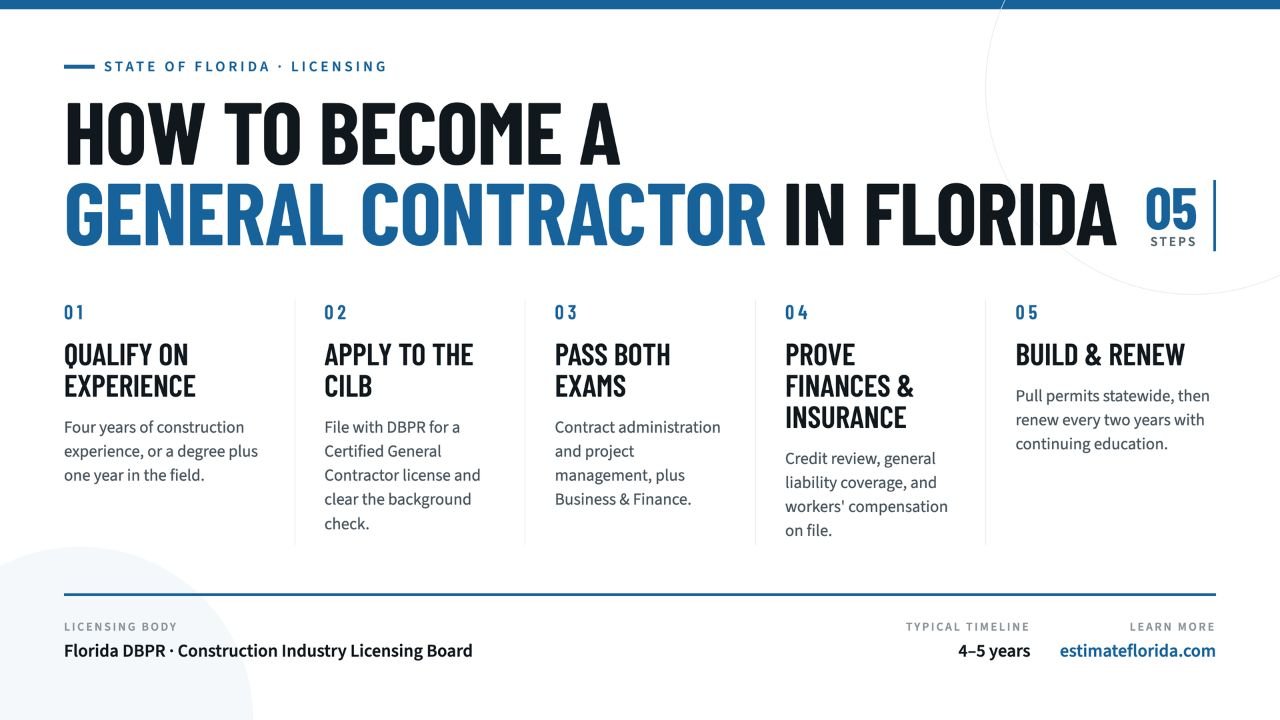
The Florida Construction Industry Licensing Board establishes clear eligibility standards to ensure that license applicants have practical, real-world construction capabilities. To qualify for a General Contractor license, you must be at least 18 years of age and satisfy one of the recognized combination pathways of field experience and formal education.
Qualifying Pathways
-
Pathway 1: Field Experience Route
-
Requires 4 years of active field experience as a worker or apprentice.
-
Must include at least 1 year as a supervisor or foreman managing crew members.
-
Experience for a Certified General Contractor license must involve work on structural elements such as foundations/slabs exceeding 20,000 square feet, elevated slabs, structural masonry walls, steel erection, column erection, or formwork for reinforced concrete.
-
-
Pathway 2: College Degree Route
-
Requires a 4-year accredited degree in building construction, architecture, or engineering.
-
Requires 1 year of proven field experience as a foreman or supervisor in the general contractor category (minimum 2,000 hours).
-
-
Pathway 3: Combined Education & Experience Route
-
3 years of accredited college credits plus 1 year of foreman experience.
-
2 years of accredited college credits plus 2 years of field experience (with at least 1 year as a foreman).
-
1 year of accredited college credits plus 3 years of field experience (with at least 1 year as a foreman).
-
Essential Construction Competencies
Beyond meeting basic time thresholds, candidates must understand essential site operations. Mastery over what are the 7 stages of construction — from pre-construction planning and site preparation to framing, rough-ins, and final handover — gives applicants the real-world context needed to verify supervisory responsibilities. Furthermore, strong proficiency in residential construction estimating ensures that prospective general contractors can evaluate material takeoff sheets and manage budget risk before executing state-level work.
Exam and Application Process
Understanding how to become a general contractor in Florida requires following a structured sequence. Skipping steps or submitting incomplete applications can delay approval by several months.
Breakdown of the State Exams
Florida’s contractor examinations are open-book tests scored as a straight percentage (70% minimum pass mark):
-
Business and Finance Exam: 120 questions over 6.5 hours covering accounting, Florida lien laws, payroll taxes, safety regulations, and Chapter 489 statutes.
-
Contract Administration Exam: 60 questions over 4.5 hours testing plan reading, site layout, structural codes, contract documents, and site management.
-
Project Management Exam: 60 questions over 4.5 hours evaluating project execution, site safety, material handling, quality control, and cost controls.
Financial, Insurance, and Background Requirements
Florida enforces strict financial and moral character standards to protect consumers and subcontractors from financial default or unethical practices.
Credit Score and Financial Responsibility
Applicants must submit personal credit reports (and business credit reports if qualifying a corporation or LLC) from a nationally recognized credit reporting agency.
-
Minimum Threshold: The licensing board looks for a FICO credit score of 660 or higher.
-
Lower Credit Scores: If your score is below 660, you can still qualify by purchasing a financial responsibility surety bond ($20,000 for Division I) or taking an approved 14-hour financial responsibility course.
Insurance Coverage Limits
General contractors in Florida must maintain minimum commercial insurance coverage before activating their license:
-
Bodily Injury Liability: Minimum $300,000 per occurrence.
-
Property Damage Liability: Minimum $50,000 per occurrence (or $300,000 combined single limit).
-
Workers’ Compensation: Proof of Florida workers’ compensation insurance or an approved state exemption for eligible corporate officers.
Business Setup After Licensure
Passing your state exams and receiving board approval are major milestones, but operating as a licensed contractor requires building a legitimate business structure.
1. Corporate Registration & Qualifying Agent
If operating as an LLC or corporation, your entity must be registered with the Florida Department of State Division of Corporations (Sunbiz). Your DBPR license will list you as the primary “qualifying agent,” binding your license to the company’s contracts and liability.
2. Accounting and Estimating Systems
General contractors manage complex cash flows, progress billing, retainage, and material procurement. Successful firms rely on standardized accounting and budgeting tools. Utilizing a sample BOQ for house construction excel complete format with example allows new business owners to calculate bill of quantities (BOQ), track material takeoffs, and present transparent bids to prospective clients.
3. Permitting and Local Registration
Although a Certified General Contractor license allows work statewide, local county and municipal building departments require contractors to register their state license, liability insurance, and local tax certificates before issuing building permits within their jurisdiction.
How to Prepare as an Aspiring General Contractor
Depending on your current role in the construction industry, your strategy for earning a Florida contractor license will focus on different preparation milestones.
For Carpenters, Tradespeople, and Foremen
-
Focus Area: Documenting supervisory hours and broadening exposure beyond a single trade.
-
Action Steps: Speak with your employing contractor about taking on multi-trade site supervision. Ask to gain direct experience on foundations, concrete formwork, structural masonry, and steel erection.
For Project Managers and Construction Management Graduates
-
Focus Area: Documenting field-level supervision and mastering Florida building code specifics.
-
Action Steps: Log at least 2,000 hours of active field management. Dedicate study time to Florida-specific building codes, wind mitigation requirements, and state lien laws.
For Commercial and Residential Builders Expanding into Florida
-
Focus Area: State regulatory compliance and open-book exam navigation.
-
Action Steps: Review Florida’s hurricane resistance building codes and corporate qualifying rules. Invest in professional tabs and highlighting guides for the state reference books.
Costs and Time to Become Licensed
Planning your financial budget and timeline prevents unexpected delays during your licensing journey.
Estimated Cost Breakdown
| Expense Item | Estimated Cost Range | Notes |
| Exam Application & State Fees | $250 – $450 | DBPR and testing vendor fees |
| Reference Books & Code Manuals | $800 – $1,800 | Open-book state exam references |
| Exam Prep Resources (Optional) | $500 – $1,200 | Structured study materials for higher first-time pass rates |
| Credit Reports & Fingerprinting | $100 – $200 | Livescan (FDLE) and credit score reports |
| General Liability & Bond Fees | $1,000 – $3,500+ | Dependent on credit score and company size |
| Total Initial Investment | $2,650 – $7,150 | Complete cost from study prep to license activation |
Realistic Timeline
-
Study & Exam Preparation: 2 to 4 months of structured review.
-
Examination Phase: 1 to 2 months to schedule and pass all three exam divisions.
-
Board Review & Processing: 30 to 90 days after submitting all paperwork to the CILB.
-
Total Timeframe: Expect a total duration of 6 to 12 months from initial prep to active license issuance.
Projecting Business Scale and Opportunity
Once licensed, general contractors can bid on a wide range of projects. Understanding market cost structures across residential and commercial sectors helps you build accurate estimates. Knowing how much does it cost to build a house in Florida equips you to advise custom home clients on realistic land, labor, and material budgets. Similarly, evaluating how much does it cost to build a warehouse in Florida prepares your firm for commercial bids, tilt-wall construction projects, and industrial site developments.
Final Thoughts
Learning how to become a general contractor in Florida requires commitment, technical study, and thorough preparation, but the financial and professional rewards are substantial. By selecting the correct license category (CGC, CBC, or CRC), verifying your structural supervisory experience, passing your state exams, and maintaining financial stability, you set a firm foundation for a long construction career.
Start by gathering your employment records, pulling your credit report, and setting up an organized study schedule for the state examination. Choosing your licensing track early ensures every step you take brings you closer to building legally and successfully across the State of Florida.