
A well-prepared bill of quantities for a general construction project is the foundation of accurate tender pricing, clear scope definition, and smooth cost control on any building project. Whether you are bidding on a residential home, commercial office, institutional building, or small industrial facility, a structured BOQ helps you price each component correctly, avoid costly omissions, and communicate clearly with clients and consultants.
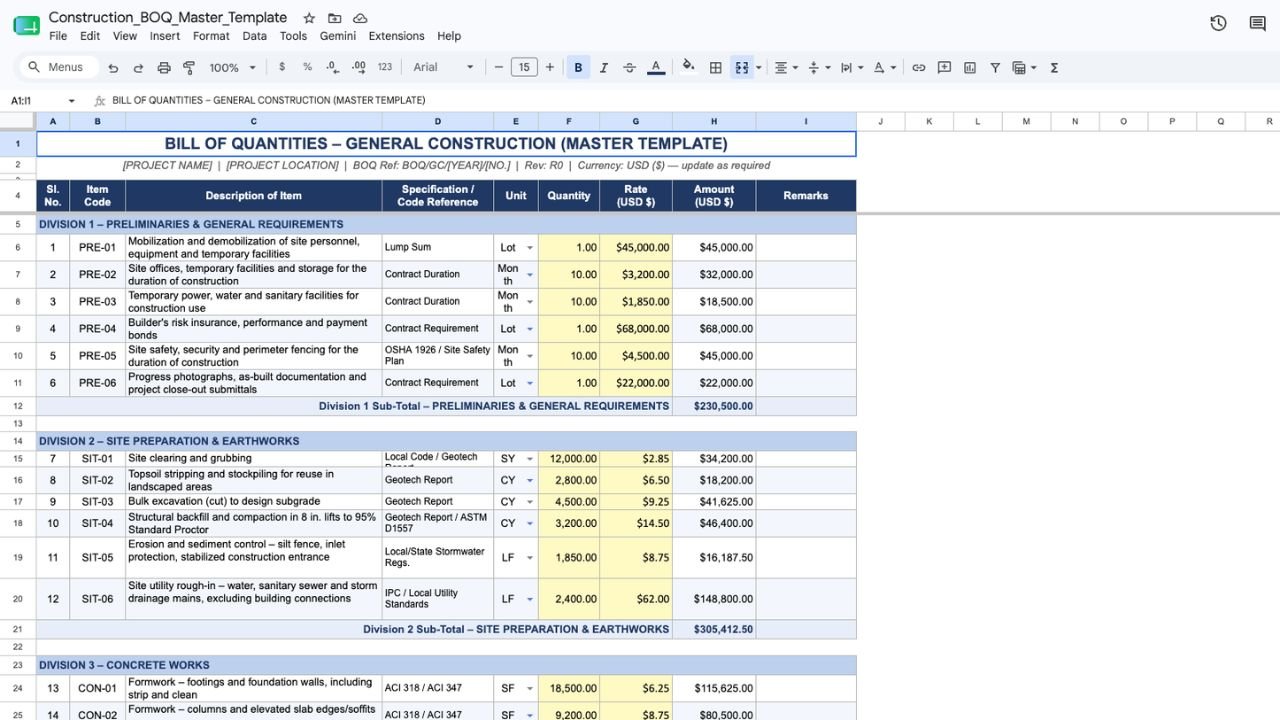
This guide walks you through exactly how to prepare a bill of quantities for a general construction project, from collecting drawings to finalizing rates and totals. You will learn what a general construction BOQ is, why it matters, how to structure items and descriptions, and which mistakes to avoid. You will also see how Estimate Florida’s Construction BOQ Template can save hours of setup time and reduce errors on every project.
👉Buy Construction BOQ Template at $97 Only
What Is a Bill of Quantities for a General Construction Project?
A Bill of Quantities (BOQ) for a general construction project is a structured list of all work items required to complete a building. Each item includes a clear description, unit of measurement, quantity, unit rate, and total amount. The BOQ is used for tendering, contract administration, progress payments, and cost tracking.
In practical terms, a general construction BOQ answers:
-
What work is included in the scope?
-
In what quantities and units?
-
At what rates per unit?
-
For what total cost?
Typical items in a building project BOQ include:
-
Civil works: earthwork, concrete, masonry, plastering, flooring, and finishes.
-
Structural works: foundations, columns, beams, slabs, stairs, and lintels.
-
Finishes: painting, tiling, ceilings, joinery (doors, windows, cabinets), and fixtures.
-
Basic MEP preliminaries: if part of the main contract, items like conduits, boxes, or rough-ins may be included.
-
External works: compound wall, paving, landscaping, drainage, and site development (if in scope).
A general construction BOQ differs from a simple material list, which focuses only on quantities, and from a high-level budget estimate, which may use lump-sum or per-square-foot rates without itemizing work in detail.
Why a Proper Construction BOQ Matters
A professional construction BOQ delivers real business value beyond just “looking good.” Key benefits include:
-
Accurate bidding: Helps you price each component correctly instead of guessing a lump-sum rate that may hide risks.
-
Clear scope definition: Reduces ambiguity about what is included or excluded in the contract, minimizing disputes later.
-
Better cost control: Enables tracking of actual quantities and costs against the estimate during construction.
-
Fair variations and claims: Provides a clear basis for pricing additional or omitted items without arguments.
-
Professional image: Shows clients and consultants that you estimate in a structured, transparent, and defensible way.
A well-structured BOQ is especially important for multi-trade building projects where many items interact. Missing a single category like waterproofing, skirting, or external works can lead to significant financial exposure.
👉Buy Construction BOQ Template at $97 Only
Step-by-Step: How to Prepare a Bill of Quantities for a General Construction Project
Follow this practical, step-by-step process to prepare a professional bill of quantities for a general construction project.
Step 1: Collect and Review All Relevant Documents
Start by gathering all information that defines the project scope:
-
Architectural drawings: plans, sections, elevations, and finish schedules.
-
Structural drawings: foundations, columns, beams, slabs, and reinforcement details.
-
Basic MEP drawings: if part of your scope, review electrical, plumbing, and HVAC preliminaries.
-
Specifications: material grades, finishes, workmanship standards, and any special requirements.
-
Client-specific BOQ formats or measurement rules: some owners or consultants require specific structures or item breakdowns.
Check for:
-
Dimensions, levels, and areas (floor areas, wall heights, roof slopes).
-
Construction details (wall types, floor finishes, roof details, waterproofing locations).
-
Special requirements (waterproofing, fire-rating, acoustics, thermal insulation).
Missing or misunderstood information at this stage leads directly to errors in the BOQ, so invest time here.
👉Buy Construction BOQ Template at $97 Only
Step 2: Define the BOQ Structure and Item Groups
Decide on logical groups that match how the work will be measured and paid. Common groups for a general building project include:
-
Preliminaries and general items (site setup, temporary works, safety, cleaning).
-
Earthwork and excavation (cut, fill, disposal, backfilling).
-
Concrete works (foundations, columns, beams, slabs, stairs, lintels, sills, chajjas).
-
Masonry and blockwork (external walls, internal partitions, parapets).
-
Plastering and rendering (internal walls, external walls, ceilings).
-
Flooring and finishes (tiles, terrazzo, marble, wood, carpet).
-
Painting and decoration (primers, emulsion, enamel, textures).
-
Joinery and carpentry (doors, windows, frames, cabinets, shutters).
-
Waterproofing and damp-proofing (basements, wet areas, terraces, roofs).
-
External works (compound wall, gates, paving, landscaping, drainage).
-
Basic MEP items (if included in main contract).
This grouping makes the BOQ easier to read, audit, and align with contract payment milestones.
Step 3: Perform a Detailed Quantity Take-Off
Go through each drawing systematically and:
-
Measure lengths, areas, volumes, and counts.
-
Record quantities for earthwork (excavation, backfilling), concrete (by grade and element), masonry (by wall type and thickness), plastering (internal/external, by surface), flooring (by room and material), painting (by surface and number of coats), doors, windows, and other joinery, and external works (compound wall length, paving area, etc.).
Include allowances for:
-
Wastage in materials (as per standard practice, e.g., 2–5% for concrete, 5–10% for tiles).
-
Items that are not fully detailed but are clearly required (e.g., lintels over all openings, sills, chajjas, damp-proof courses).
Cross-check between drawings and your take-off sheet to avoid missing items or double-counting.
Step 4: Write Clear and Complete Item Descriptions
Each BOQ item description should be specific enough to avoid ambiguity. Include:
-
Type of work: e.g., “reinforced concrete columns,” “blockwork walls,” “ceramic tile flooring.”
-
Material specifications: e.g., concrete grade, block size, tile type, paint brand or performance spec.
-
Scope included: e.g., “supply and install,” “including scaffolding,” “including curing.”
-
Any special requirements: waterproofing, surface preparation, priming, sealing.
Example description:
“Reinforced concrete columns, grade 30, including formwork, reinforcement, supply and placement of concrete, and curing.”
Clear descriptions reduce disputes and variations during construction and billing.
👉Buy Construction BOQ Template at $97 Only
Step 5: Assign Appropriate Units of Measurement
Use units that align with contract norms and industry practice:
-
Cubic meters (m³) for earthwork and concrete.
-
Square meters (m²) for masonry, plastering, flooring, painting.
-
Meters (m) for linear items like skirting, cornices, copings, gutters.
-
Number (nos.) for doors, windows, manholes, fixtures, and similar counted items.
Ensure consistency:
-
Do not mix units for similar items (e.g., m² and ft² in the same BOQ without clear conversion).
-
Keep units consistent with how rates will be quoted and how the contract measures work.
Step 6: Build Up Unit Rates for Each Item
Derive unit rates by breaking down each cost component:
-
Material cost: Based on current market prices for cement, sand, aggregate, blocks, tiles, paint, doors, windows, etc. Include wastage allowance.
-
Labor cost: Based on productivity norms and local wage rates for masons, carpenters, tilers, painters, helpers, etc.
-
Equipment and tools: Mixers, vibrators, scaffolding, small tools, and any specialized equipment.
-
Overheads and profit: Site and head office overheads, contingency, and profit margin.
The total unit rate is the sum of these components. Some BOQs show these as separate columns for transparency, while others combine them into a single “Unit Rate” column for simplicity.
Step 7: Populate the BOQ with Quantities and Rates
Enter the following for each item:
-
Item descriptions.
-
Units.
-
Quantities from the take-off.
-
Unit rates (either combined or broken down by component).
Calculate:
-
Amount for each item = Quantity × Unit Rate.
Use a spreadsheet (Excel/Google Sheets) or estimating software to:
-
Automate calculations.
-
Reduce manual errors.
-
Make updates easier when quantities or rates change.
This is exactly where a structured template saves significant time and reduces the risk of formula errors.
Step 8: Add Summaries, Subtotals, and Totals
Create a clear summary section that shows:
-
Subtotals for each major group (concrete, masonry, finishes, joinery, external works, etc.).
-
A grand total for the entire construction scope.
If not included in unit rates, add separate sections for:
-
Preliminaries and general items.
-
Site overheads.
-
Head office overheads.
-
Contingency.
-
Profit.
Ensure all totals are calculated using formulas, not hard-coded numbers, to avoid mismatches when data changes.
Step 9: Review, Cross-Check, and Finalize
Before issuing the BOQ, check for:
-
Missing items or scopes (lintels, sills, chajjas, skirting, waterproofing, external works).
-
Inconsistent units or descriptions.
-
Calculation errors in rates, amounts, or totals.
-
Alignment with specifications and contract measurement rules.
Compare:
-
Total quantities (e.g., concrete volume, masonry area) with approximate rules of thumb or past projects.
-
Overall cost per square foot or meter with benchmarks or similar completed projects.
Finalize:
-
Clean formatting (headers, borders, consistent number formats).
-
Clear file naming (project name, date, version).
👉Buy Construction BOQ Template at $97 Only
Sample BOQ Sections for a General Construction Project (Illustrative)
The table below illustrates typical BOQ items for a general building project, focused on civil works. In a real BOQ, you would have many more items (flooring, painting, doors/windows, external works, etc.), organized into clear groups with formula-driven calculations.
👉Buy Construction BOQ Template at $97 Only
Notes:
-
This is an illustrative example; actual items, quantities, and rates must be project-specific.
-
A proper template organizes these items into clear groups and uses formulas for all calculations.
-
Additional sections would cover flooring, painting, joinery, waterproofing, and external works.
👉Buy Construction BOQ Template at $97 Only
Common Mistakes When Preparing a Construction BOQ
Avoid these frequent errors to keep your BOQ accurate and defensible:
-
Incomplete take-off: Missing items like lintels, sills, chajjas, skirting, or external works leads to underestimation.
-
Vague descriptions: Items like “concrete work” or “finishes” without specifying grades, thickness, or scope invite disputes during billing.
-
Inconsistent units: Mixing m² and ft², or m³ and cu ft, without clear conversion causes calculation errors.
-
Ignoring wastage: Not allowing for material wastage in concrete, blocks, tiles, etc. understates material costs.
-
Overlooking preliminaries: No items for site setup, temporary facilities, safety, cleaning, or mobilization.
-
Hard-coded totals: Typing totals instead of using formulas leads to errors when quantities or rates change.
-
Misalignment with contract: BOQ structure that does not match how the contract measures and pays for work creates billing friction.
Each of these mistakes can lead to wrong estimates, disputes, or financial losses. A standardized, step-by-step approach reduces these risks significantly.
How Estimate Florida’s Construction BOQ Template Helps
If you regularly prepare BOQs for general construction projects, building them from scratch for every job is time-consuming and error-prone. Estimate Florida’s Construction BOQ Template is designed specifically for general contractors, civil contractors, and estimators who want a professional, ready-to-use BOQ structure.
What it includes:
-
Pre-built item groups aligned with typical building scopes: preliminaries, earthwork, concrete, masonry, plastering, flooring, painting, joinery, waterproofing, external works, and summaries.
-
Clear columns for descriptions, units, quantities, component rates (material, labor, equipment), total unit rates, and amounts.
-
Built-in formulas for automatic calculation of unit rates, amounts, subtotals, and grand totals.
-
Professional, client-ready formatting suitable for bids, internal reviews, and progress billing.
Benefits:
-
Saves hours of setup time on each new project.
-
Reduces the risk of missing items, wrong units, or calculation errors.
-
Provides a consistent BOQ structure that can be used across your team.
-
Makes it easy to update quantities or rates without breaking the sheet.
This template can be used for:
-
Residential buildings.
-
Commercial and institutional projects.
-
Small industrial and warehouse-type buildings (civil portion).
If you want a ready-to-use BOQ structure instead of building one from scratch, you can use our Construction BOQ Template, available here: 👉Buy Construction BOQ Template at $97 Only
This template is built from real projects and refined over years of estimating work in Florida and beyond.
Best Practices for Construction BOQ Preparation
Adopt these best practices to improve accuracy, speed, and professionalism over time:
-
Start with a master template: Maintain a clean, project-free version with standard groups, columns, and formulas that can be reused for every new job.
-
Keep descriptions consistent: Use a standard wording pattern for similar items across projects to improve readability and reduce ambiguity.
-
Maintain a rate library: Keep a separate sheet or file with standard material, labor, and equipment rates. Update it periodically based on market changes.
-
Use clear file naming and version control: Example: “ProjectX_ConstructionBOQ_v2_2026-07.xlsx” to avoid confusion between versions.
-
Cross-check with past projects: Compare total quantities and cost per square foot or meter with similar completed projects to validate your estimate.
These practices turn BOQ preparation into a repeatable, reliable process that scales with your business.
Final Thoughts: Make BOQ Preparation a Repeatable Process
Knowing how to prepare a bill of quantities for a general construction project is a core skill for any estimator or contractor working on building projects. A structured approach reduces errors, improves bid quality, and supports better cost control from tender through completion.
Estimate Florida understands the demands of general construction estimating and BOQ preparation. We help contractors and consultants turn complex scopes into clear, defensible, and profitable bids across residential, commercial, and institutional projects.
Use this guide as a checklist for your own BOQs. Start with the core sections, add detailed items for each group, ensure your columns and formulas are sound, and test the template on a small project before rolling it out company-wide. If you want to accelerate the process and standardize your BOQs, consider adopting a pre-built solution like the Construction BOQ Template from Estimate Florida to streamline your workflow and improve consistency.
If you need help with broader construction estimating, Estimate Florida also provides concrete, electrical, MEP, and structural steel estimating services for contractors across the US. Whether you are a general contractor managing multiple trades or a specialist subcontractor, having a reliable BOQ foundation is a strategic advantage.