
On construction projects, people often use the terms BOQ and BOM interchangeably, but they serve very different purposes. Understanding the difference between BOQ and BOM in construction is essential for accurate estimating, clear contracts, efficient procurement, and better cost control. Confusing these documents can lead to pricing errors, procurement mismatches, and disputes over what is included in a scope.
 Buy Construction BOQ Template at $97 Only
This guide defines what a Bill of Quantities (BOQ) is, what a Bill of Materials (BOM) is, and shows the key differences in purpose, audience, structure, and use. You will see practical examples from general building construction and structural steel packages, learn when to use each document, and understand why keeping them distinct matters for your business. Professional templates, like the Construction BOQ Template and Structural Steel Works BOQ Template from Estimate Florida, help you implement these documents correctly, with details later in this post.
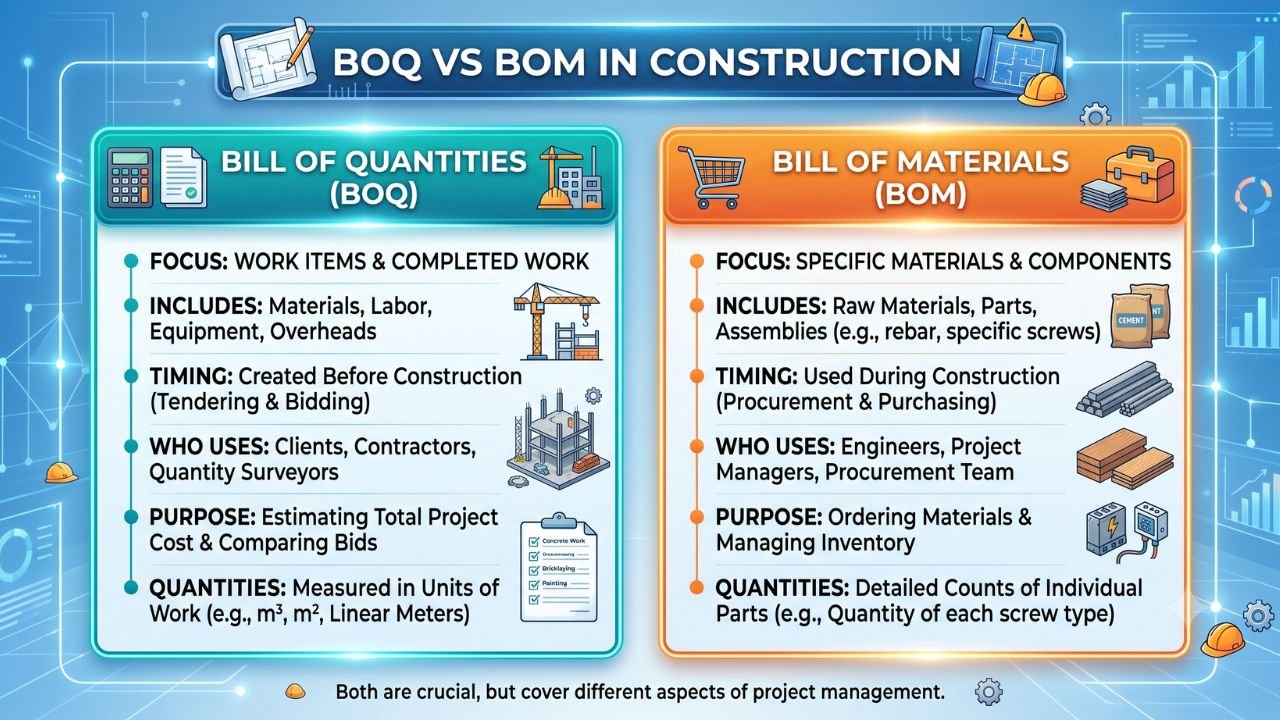
What Is a Bill of Quantities (BOQ) in Construction?
A Bill of Quantities (BOQ) in construction is a structured list of work items with descriptions, units, quantities, rates, and amounts. It is focused on measured work, such as cubic meters of concrete, square meters of blockwork, or tons of structural steel. The BOQ translates drawings and specifications into a commercial document that can be priced, contracted, and used for progress billing.
Typical uses of a BOQ include:
-
Tendering and bidding: All contractors price the same scope in a comparable way.
-
Contract documentation: Clearly defines what work is included and how it will be measured.
-
Progress billing and valuations: Quantities completed are measured against BOQ items for interim payments.
-
Cost planning and budget control: Provides a baseline for tracking actual costs versus estimate.
Typical audiences for a BOQ are:
-
Main contractors and subcontractors.
-
Quantity surveyors and consultants.
-
Clients and owners.
A simple BOQ example for concrete work might read:
“Reinforced concrete columns, grade 30, including formwork and reinforcement – 35 m³ @ $230/m³ = $8,050.”
A BOQ is usually trade-based (civil, architectural, structural, MEP) and aligned with how work is measured and paid under the contract.
Buy Construction BOQ Template at $97 Only
What Is a Bill of Materials (BOM) in Construction?
A Bill of Materials (BOM) in construction is a detailed list of materials, components, and parts required to fabricate or assemble a product or package. It is focused on what materials and components are needed, not on measured trade work. BOMs are common in manufacturing, fabrication, and specialized packages where exact parts and quantities must be ordered and produced.
Typical uses of a BOM include:
-
Manufacturing and fabrication: Steel fabricators, precast producers, joinery shops, and MEP package suppliers use BOMs to plan production.
-
Procurement and purchasing: Orders are placed for exact quantities of materials and components.
-
Production planning and shop drawings: BOMs are generated from detailed designs or BIM models to drive fabrication.
Typical audiences for a BOM are:
-
Fabricators and manufacturers.
-
Suppliers and vendors.
-
Procurement teams.
-
Detailers and design engineers.
A simple BOM example for a steel package might include:
-
W12×26 beams – 120 pieces, length 6 m.
-
A325 bolts M20×60 – 480 nos.
-
Gusset plates 10 mm – 240 kg.
A BOM is often component-level, sometimes down to each bolt, plate, or profile, and is used to make or buy the items.
Buy Construction BOQ Template at $97 Only
BOQ vs. BOM: Key Differences at a Glance
The table below summarizes the key differences between BOQ and BOM in construction.
BOQs are about what work is done and how much, while BOMs are about what materials and parts are needed to produce that work. A single BOQ line, such as “structural steel columns – 25 tons,” may correspond to a very detailed BOM with many different sections, plates, and bolts. On integrated projects, both documents coexist and must be kept consistent through design revisions and change orders.
Buy Construction BOQ Template at $97 Only
When to Use a BOQ vs. a BOM in Construction Projects
Knowing when to use a BOQ versus a BOM helps you choose the right document for the right job.
Use a BOQ when:
-
You are preparing tender documents for a building or infrastructure project.
-
You need all contractors to price the same scope in a comparable way.
-
You want a document for progress billing and variation pricing.
-
You are working as a main contractor, QS, or consultant managing trade contracts.
Use a BOM when:
-
You are a fabricator or manufacturer (steel, precast, joinery, MEP packages).
-
You need to order materials and plan production for a defined package.
-
You are working from shop drawings or BIM models to generate component lists.
-
You need to track part numbers, sizes, grades, and quantities for fabrication or purchase.
Many packages use both documents:
-
A BOQ for the commercial and contract side (e.g., “supply and erect structural steel – X tons”).
-
A BOM for the technical and procurement side (exact members, plates, bolts, etc.).
Practical Example: BOQ and BOM on a Structural Steel Package
To make the difference concrete, consider a simple warehouse steel frame.
BOQ item example:
“Supply, fabrication, and erection of structural steel columns, A992 W-shapes, including base plates, shop primer, and two coats of paint – 25 tons @ $2,200/ton = $55,000.”
This single BOQ line covers material, fabrication, erection, and surface protection as a work package. It is used to price and contract the steel work with a subcontractor or client.
Corresponding BOM (simplified) for the same scope might include:
-
Members:
-
W12×26 columns – 20 pieces, 6 m each.
-
W14×30 columns – 10 pieces, 8 m each.
-
-
Plates:
-
Base plates 20 mm – 30 pieces, various sizes.
-
Gusset plates 10 mm – 120 pieces.
-
-
Fasteners:
-
A325 bolts M20×60 – 480 nos.
-
Anchor bolts M24 – 80 nos.
-
The BOQ is used to price and contract the steel work. The BOM is used by the fabricator to detail, order, and produce the steel. A well-structured Structural Steel Works BOQ Template from Estimate Florida helps you define the BOQ side clearly, while fabricators typically generate the BOM from their detailing software.
Practical Example: BOQ and BOM in General Building Construction
Consider a concrete work package for a residential or commercial building.
BOQ example (concrete work):
“Reinforced concrete columns, grade 30, including formwork, reinforcement, supply and placement of concrete, and curing – 35 m³ @ $230/m³ = $8,050.”
This BOQ item covers concrete, reinforcement, formwork, labor, and related activities as a measured work item. It is used for tendering and billing the concrete work.
Corresponding BOM (simplified) for the same scope might include:
-
Cement – X bags.
-
Sand – Y m³.
-
Aggregate – Z m³.
-
Rebar 16 mm – A tons.
-
Rebar 12 mm – B tons.
-
Formwork plywood – C sheets.
-
Nails, ties, and accessories – assorted quantities.
The BOQ is used for tendering and billing the concrete work. The BOM (or material schedule) is used for procurement and site material planning. Many contractors maintain internal BOMs or material schedules derived from the BOQ quantities to manage purchasing and wastage.
Buy Construction BOQ Template at $97 Only
Why Understanding BOQ vs. BOM Matters for Your Business
Understanding the difference between BOQ and BOM in construction has direct impacts on your estimating, procurement, and project control.
-
Accurate estimating: Confusing BOQ and BOM can lead to double-counting or missing costs, such as counting materials in both documents without aligning scope.
-
Clear contracts and fewer disputes: When tender documents clearly use a BOQ for work items, and subcontractors use BOMs internally, scope and pricing are clearer.
-
Better procurement planning: Knowing that BOMs drive material ordering helps you plan lead times, storage, and cash flow more effectively.
-
Improved cost control: You can compare BOQ quantities (work done) with BOM quantities (materials consumed) to monitor wastage and productivity.
-
More professional documentation: Using the right document for the right purpose improves your credibility with clients, consultants, and suppliers.
Mature companies deliberately separate these documents and keep them consistent through revision control and clear naming conventions.
Common Confusions and Mistakes Between BOQ and BOM
Avoid these frequent errors that arise from confusing BOQ and BOM:
-
Treating a BOQ as a purchase list: Trying to order materials directly from a BOQ without breaking it down into a BOM or material schedule leads to incomplete or incorrect orders.
-
Using a BOM as a tender document: Sending a component-level BOM to main contractors instead of a trade-based BOQ makes bids incomparable and confusing.
-
Assuming BOQ rates include every nut and bolt: While the BOM shows all components, the BOQ may group them into broader work items; mismatches can cause disputes over what is included.
-
Inconsistent revisions: Updating drawings and BOMs but not reflecting changes in the BOQ (or vice versa) leads to quantity and cost mismatches.
-
Mixing labor into a BOM: BOMs are typically materials and components only; labor should be in the BOQ or separate cost sheets.
Each of these mistakes can cause pricing errors, procurement issues, or disputes. Clear documentation practices and a solid understanding of BOQ vs. BOM reduce these risks significantly.
Buy Construction BOQ Template at $97 Only
How Estimate Florida’s BOQ Templates Help You Implement This Correctly
If you want to implement BOQs and BOMs correctly on your projects, Estimate Florida offers structured templates that align with industry best practices.
Construction BOQ Template – for general building and civil works:
-
Structured by trade (earthwork, concrete, masonry, finishes, external works, etc.).
-
Designed to align with how contracts measure and pay for work.
-
Includes clear columns for descriptions, units, quantities, rates, and amounts.
-
Available here:
Buy Construction BOQ Template at $97 Only
Structural Steel Works BOQ Template – for structural steel packages:
-
Organized by primary steel, secondary steel, accessories, surface protection, erection, and more.
-
Helps you define clear BOQ items that match how steel work is priced and contracted.
-
Works well alongside fabricators’ BOMs generated from detailing software.
Benefits of using these templates:
-
Saves time setting up BOQs from scratch.
-
Reduces risk of missing items or misclassifying work.
-
Provides a consistent, professional structure that works well alongside fabricators’ BOMs.
-
Makes it easier to link BOQ quantities to internal material schedules or BOMs for procurement.
These templates are built from real projects and refined over years of estimating work in Florida and beyond.
Best Practices for Using BOQs and BOMs Together
To get the most value from both documents, adopt these best practices:
-
Start with a clear BOQ structure: Define work items by trade and measurement rules before diving into materials.
-
Derive material schedules/BOMs from BOQ quantities: Use BOQ quantities as a basis, then break them down into materials and components for procurement.
-
Keep naming and revision control aligned: Ensure drawing revisions, BOQ revisions, and BOM revisions are coordinated to avoid mismatches.
-
Clarify scope boundaries: Agree whether a BOQ line includes all accessories and fixings or if some items are covered separately in other packages.
-
Use BOQ for commercial control, BOM for procurement: Track progress and payments against the BOQ. Plan purchasing and fabrication using the BOM.
These practices improve coordination between commercial, technical, and procurement teams and reduce the risk of errors and disputes.
Final Thoughts: Use the Right Document for the Right Job
A BOQ is for pricing and managing measured construction work. A BOM is for listing materials and components needed to fabricate or procure that work. Understanding BOQ vs. BOM in construction helps you estimate more accurately, procure more efficiently, and avoid costly misunderstandings on your projects.
Estimate Florida understands the demands of construction and steel estimating documentation. We help contractors and consultants turn complex scopes into clear, defensible, and profitable bids across residential, commercial, and industrial projects.
Use this guide to clarify how you use BOQs and BOMs on your projects. If you want to accelerate the process and standardize your documentation, consider adopting structured templates like the Construction BOQ Template and Structural Steel Works BOQ Template from Estimate Florida.
If you need help with broader construction estimating, Estimate Florida also provides concrete, electrical, MEP, and structural steel estimating services for contractors across the US. Whether you are a general contractor managing multiple trades or a specialist subcontractor, having reliable BOQ and BOM practices is a strategic advantage.