Maintaining a golf course is an ongoing, multi-faceted operational commitment that balances agronomic science, heavy machinery management, labor logistics, and environmental stewardship. For golf course owners, club managers, developers, grounds supervisors, and property investors, establishing an accurate maintenance budget is critical to maintaining playable conditioning while safeguarding long-term asset value.
How Much Does It Cost to Maintain a Golf Course?
Maintaining a standard 18-hole golf course typically costs between $500,000 and $1,500,000+ per year, or roughly $40,000 to $125,000+ per month. Highly manicured resort courses, private country clubs, and PGA tournament venues frequently spend $1.5 million to $3.5 million+ annually. Annual costs depend on course acreage, maintenance standards, local labor markets, irrigation availability, equipment ownership, and regional climate conditions.
Golf Course Maintenance Costs vs. Golf Course Operating Costs
When evaluating golf course financials, it is essential to distinguish between maintenance costs and overall operating costs. Combining these distinct budget categories can lead to significant financial miscalculations during acquisition, development, or annual forecasting.
Golf Course Maintenance Costs
Golf course maintenance costs refer strictly to the expenses required to care for, preserve, and groom the physical grounds, turfgrass, and exterior environmental infrastructure. Primary maintenance categories include:
- Turf Management: Mowing, verticutting, topdressing, aerifying, and overseeding greens, tees, fairways, and roughs.
- Agronomics & Plant Health: Fertilizer applications, soil conditioners, fungicides, herbicides, insecticides, and nematicides.
- Irrigation & Water Management: Pump station power, system repairs, backflow prevention, line flushing, and water access fees.
- Bunker & Landscape Care: Hand raking, mechanical edging, sand replenishment, tree pruning, mulch, and flowerbed care.
- Grounds Labor & Fleet: Payroll for the superintendent, assistant superintendents, mechanics, and grounds technicians, plus mower leases, fuel, and equipment repairs.
- Hardscape Maintenance: Basic patching and cleaning of cart paths, drainage swales, retention ponds, and bridges.
Golf Course Operating Costs
Golf course operating costs encompass the total expenditure required to run the entire facility as a commercial business enterprise. While maintenance is one major component of operating costs, the overall operating budget also includes:
- Clubhouse & Hospitality Operations: Food and beverage service, kitchen staffing, dining area maintenance, and event coordination.
- Golf Operations & Pro Shop: Head professional and assistant professional salaries, cart attendant labor, merchandising, tee-time booking software, and golf cart fleet leases.
- Administration & Overhead: Executive management, accounting, legal fees, marketing, insurance (property, liability, umbrella), and IT infrastructure.
- Utilities & Municipal Overhead: Clubhouse HVAC, facility lighting, sewer, waste removal, property taxes, and debt service.
This guide focuses specifically on grounds and turf maintenance costs, providing a detailed breakdown for developers, facility directors, and estimators planning real-world maintenance standards.
How Much Does It Cost to Maintain a Golf Course Per Year?
Annual golf course maintenance budgets vary widely based on total maintained acreage, play volume, quality tier, and regional climate. Based on industry data from the Golf Course Superintendents Association of America (GCSAA) and national turf management benchmarks, annual turf care budgets generally fall into distinct cost bands.
| Course Quality & Facility Type | Maintained Turf Area | Annual Maintenance Cost Range | Primary Cost Factors |
|---|---|---|---|
| Small / 9-Hole Executive Course | 35 – 60 Acres | $200,000 – $450,000 | Smaller turf area, reduced labor force, simplified equipment fleet. |
| Standard 18-Hole Public / Municipal | 90 – 130 Acres | $550,000 – $1,100,000 | Moderate play volume, standard agronomic programs, practical turf standards. |
| Mid-Tier Private / Semi-Private Club | 110 – 150 Acres | $1,000,000 – $1,800,000 | High aesthetic expectations, full-time mechanic, specialized bunker care. |
| High-End Private / Championship | 120 – 180+ Acres | $1,800,000 – $3,000,000+ | Pristine greens, intensive hand-watering, custom seed blends, premium presentation. |
| Resort & PGA Tournament Facility | 140 – 200+ Acres | $2,500,000 – $4,500,000+ | Continuous tournament conditioning, extensive floral/tree landscaping, flawless turf. |
How Much Does It Cost to Maintain a Golf Course Per Month?
While an annual budget can be calculated as a monthly average (e.g., $1,200,000 per year equals $100,000 per month), actual monthly cash flow requirements are highly seasonal. Grounds maintenance spending fluctuates based on growth cycles, weather events, agronomic schedules, and labor demand.
Key Factors Causing Monthly Cash Flow Variations:
- Agronomic Application Timing: Spring core aeration, deep-tine verticutting, and major fertilizer applications concentrate chemical and material costs into specific 60-day windows.
- Irrigation Electrical Costs: Pumping millions of gallons of water during hot, dry stretches drives up monthly electric and utility bills significantly.
- Seasonal Labor Shifts: Facilities often hire additional seasonal grounds staff during fast-growth months, increasing payroll during spring and summer.
- Overseeding Programs: Purchasing thousands of pounds of ryegrass seed and executing intensive autumn prep work creates a seasonal cost spike.
- Storm Cleanup & Debris Management: High-wind storms and heavy rainfall events require unexpected overtime, equipment rentals, and specialized tree care services.
Golf Course Maintenance Cost Per Acre
Calculating maintenance cost per acre provides a normalized metric for comparing facilities of different sizes. Total golf course properties typically span 120 to 200 acres, but the actual maintained turf acreage usually ranges from 75 to 130 acres.
On average, routine golf course maintenance ranges from $5,000 to $18,000+ per maintained acre annually.
However, using a single per-acre figure across an entire property can be misleading. A golf course consists of distinct zones, each requiring vastly different labor, equipment, and chemical intensity.
Maintenance Cost Breakdown by Course Area
1. Putting Greens (3 to 5 Total Acres)
- Average Cost: $30,000 – $75,000 per acre annually.
- Maintenance Requirements: Daily mowing with precision walk-behind or specialized riding mowers (cut height often between 0.100 and 0.125 inches), frequent rolling for green speed, light weekly topdressing with specialized sand, bi-weekly micro-nutrient foliar feeding, frequent core and needle aeration, and continuous disease monitoring. Putting greens account for only 3–4% of course acreage but consume up to 25–30% of the agronomic and labor budget.
2. Tee Boxes (4 to 7 Total Acres)
- Average Cost: $10,000 – $22,000 per acre annually.
- Maintenance Requirements: Mowed 3 to 4 times weekly, daily divot filling using sand and seed mixtures, routine levelling, aeration, and targeted fertilization to encourage rapid turf recovery from heavy iron play.
3. Fairways (25 to 45 Total Acres)
- Average Cost: $4,000 – $9,000 per acre annually.
- Maintenance Requirements: Mowed 2 to 3 times weekly using lightweight reel mowers, broad-spectrum fertilization, soil-applied pre-emergent herbicides, growth regulators (PGRs) to manage clipping volume, and large-scale aeration once or twice per year.
4. Rough & Native Areas (40 to 70+ Total Acres)
- Average Cost: $1,500 – $3,500 per acre annually (Rough); $300 – $800 per acre (Native/Out-of-Bounds).
- Maintenance Requirements: Mowed 1 to 2 times weekly with rotary mowers. Cultural inputs are limited primarily to weed management and basic moisture monitoring. Native, naturalized, or wetland buffer areas require minimal mowing, focusing instead on invasive species control.
5. Sand Bunkers (2 to 5 Total Acres / 50 to 100 Bunkers)
- Average Cost: $12,000 – $25,000 per acre equivalent annually.
- Maintenance Requirements: Daily mechanical or hand raking, edge trimming, fly-mow slope management, washout repairs following heavy downpours, sand depth checks, and periodic sand replenishment.
Comprehensive Golf Course Maintenance Cost Matrix
The following matrix provides a verified overview of major golf course maintenance expense categories for a standard 18-hole golf course (100–120 maintained acres).
| Maintenance Category | Proportion of Budget | Typical Annual Cost Range | Core Expenditure Considerations |
|---|---|---|---|
| Labor & Payroll | 45% – 62% | $300,000 – $1,200,000+ | Superintendent, assistants, lead mechanic, spray tech, crew wages, taxes, benefits. |
| Equipment Fleet & Maintenance | 12% – 20% | $90,000 – $350,000 | Lease payments, mechanical repairs, replacement reels, hydraulic fluid, grinding tools. |
| Fertilizer & Chemicals | 10% – 18% | $65,000 – $250,000 | Granular nitrogen, foliar micro-nutrients, fungicides, herbicides, insecticides, wetting agents. |
| Irrigation Power & Water Access | 6% – 15% | $35,000 – $180,000 | Pumping electricity, municipal water/reclaimed water fees, pipe/valve repairs, head replacements. |
| Fuel & Lubricants | 4% – 8% | $25,000 – $80,000 | Diesel for tractors/mowers, gasoline for utility vehicles, hydraulic oils. |
| Sand, Soil & Turf Consumables | 3% – 6% | $20,000 – $65,000 | Bunker sand, topdressing sand, divot mix, seed, replacement sod patches, flags, cups, tee markers. |
| Tree Care & Landscaping | 2% – 5% | $15,000 – $60,000 | Canopy trimming, hazard tree removal, pine straw/mulch, seasonal flowerbed planting. |
| Cart Path & Drainage Upkeep | 1% – 4% | $10,000 – $40,000 | Crack sealing, edge cleaning, pipe clearing, swale re-grading, inlet box maintenance. |
1. Golf Course Maintenance Labor Costs
Labor is consistently the largest expense in any golf course grounds budget, typically accounting for 50% to 60% of total maintenance expenditure. Managing high-end turf requires a skilled team led by specialized agronomists.
Primary Staffing Roles & Organization:
- Golf Course Superintendent: Oversees agronomics, environmental compliance, staff management, administrative budgeting, and long-range planning.
- Assistant Superintendent(s): Manages daily crew operations, water management, course setup, and chemical/fertilizer applications.
- Equipment Technician / Lead Mechanic: Maintains precision cutting units, services hydraulic systems, sharpens mower reels daily, and maintains heavy machinery.
- Irrigation Technician: Monitors central control software, repairs pipe breaks, adjusts head nozzles, services electric valves, and manages pump station operations.
- Chemical / Spray Technician: Handles, measures, mixes, and applies regulated fertilizers, fungicides, insecticides, and herbicides.
- Grounds Crew Technicians & Seasonal Workers: Handle mowing, string trimming, bunker raking, divot filling, aerification, and general debris management.
Beyond base wages, labor budgets must account for payroll taxes, workers’ compensation insurance, health benefits, continuing education, pesticide applicator licensing, and seasonal overtime during rapid turf-growth periods.
2. Equipment Fleet Leasing vs. Ownership Costs
Maintaining a golf course requires a diverse fleet of highly specialized turf management machinery. Most commercial facilities utilize a 4-year or 5-year lease structure for primary mowing equipment, ensuring access to reliable machinery while stabilizing cash flow.
Essential Equipment Requirements:
- Greens Mowers: Walk-behind units ($12,000–$18,000 each) or triplex riding units ($55,000–$75,000 each).
- Fairway Mowers: Large multi-gang reel mowers ($85,000–$130,000 each).
- Rough & Trim Mowers: Heavy-duty rotary mowers ($65,000–$110,000 each).
- Specialized Machinery: Core aerators, topdressers, turf sweepers, fairway spray rigs ($70,000–$120,000), greens rollers, bunker rakes, utility vehicles ($12,000–$22,000 each), and 40–60 HP tractors.
Ownership vs. Leasing Considerations:
- Leasing: Lowers upfront capital requirements, keeps mowing equipment under warranty, and ensures high precision cuts. Typical fleet lease payments for an 18-hole facility range from $8,000 to $22,000 per month.
- Outright Purchase: Requires significant capital reserves ($800,000 to $1,500,000+ for a complete new fleet) but eliminates monthly interest costs. However, aging equipment requires higher mechanical repair budgets and leads to increased downtime.
3. Irrigation System & Water Costs
Irrigation infrastructure represents one of the most complex engineering systems on a golf course. Water sourcing and pumping expenses can dramatically impact annual operational costs:
- Pumping Station Power: High-horsepower electric VFD (Variable Frequency Drive) pump stations require substantial power, often resulting in monthly electric bills between $3,000 and $12,000+ during dry seasons.
- Water Access Fees: Courses utilizing reclaimed effluent water or municipal supplies pay per thousand gallons. Annual water purchases can range from $20,000 to $150,000+, depending on local utility rates and rainfall. Courses with permitted onsite wells or surface water rights incur lower water purchase costs, though permit compliance and pump maintenance remain major ongoing expenses.
- System Maintenance: Modern golf course irrigation systems contain 1,000 to 2,000 individual sprinkler heads, miles of high-pressure HDPE or PVC pipe, solenoid valves, and decoders. Annual head replacements, pipe repairs, and control module maintenance typically cost $12,000 to $35,000.
4. Turf Agronomics & Chemical Inputs
Maintaining healthy, disease-free turfgrass under low cutting heights and high foot traffic requires regular inputs of nutrients and plant protectants:
- Fertilizer Programs: Slow-release granular nitrogen, potassium, phosphorus, iron, and foliar micro-nutrients support turf density and root structure.
- Disease & Fungicide Control: High humidity and soil moisture invite diseases such as Dollar Spot, Pythium, Brown Patch, and Take-All Root Rot. Preventative fungicide programs are essential for protecting high-value greens.
- Weed & Pest Control: Pre-emergent and post-emergent herbicides manage crabgrass, goosegrass, and broadleaf weeds. Insecticides and nematicides protect turf root systems from destructive soil pests like mole crickets, white grubs, and sting nematodes.
Florida-Specific Golf Course Maintenance Factors
Golf courses in Florida operate in a distinct sub-tropical environment that presents unique agronomic, hydrological, and climatic challenges. Unlike northern facilities that go dormant during winter, Florida golf courses operate 12 months a year, with peak play coinciding with dry winter months and peak turf growth occurring during hot, humid summer months.1. Warm-Season Turfgrass Management
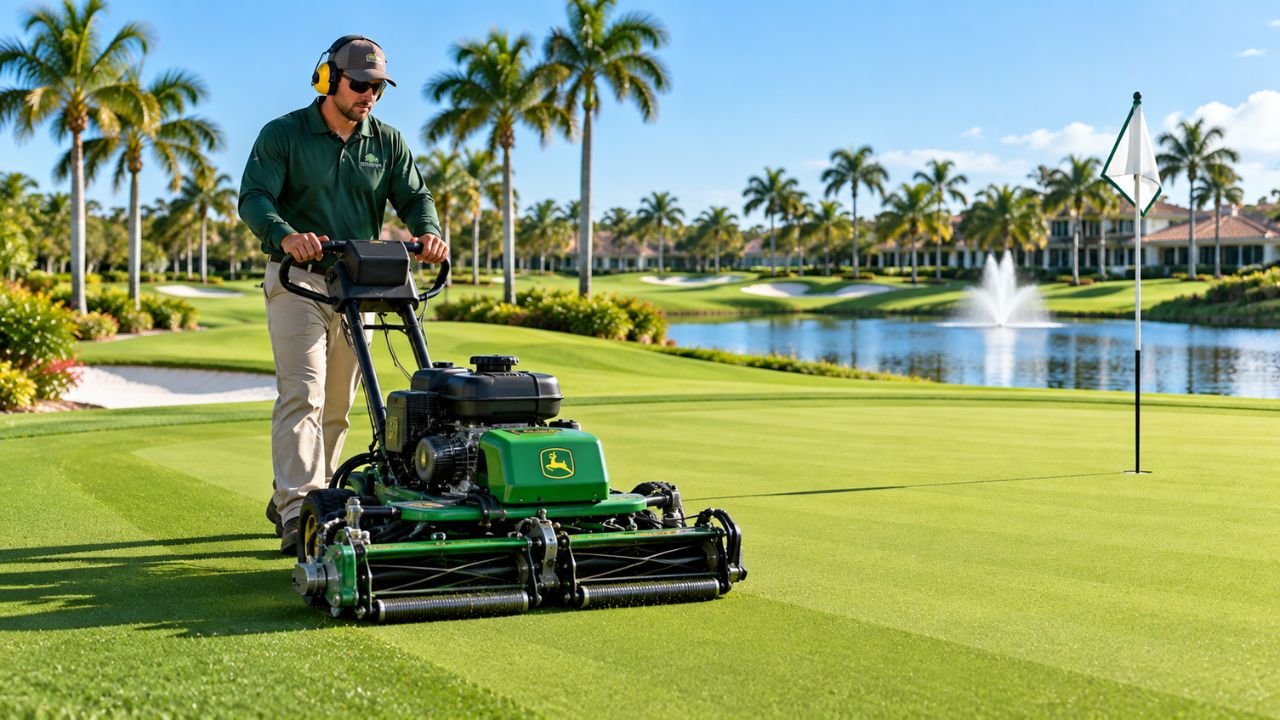
Florida golf courses rely on warm-season turf species adapted to intense heat and sandy soils according to research from the University of Florida Institute of Food and Agricultural Sciences (UF/IFAS):
- Bermudagrass (TifEagle, MiniVerde, Tifway 419, Celebration): The primary turf for Florida courses. Ultra-dwarf Bermudagrass varieties (TifEagle/MiniVerde) create fast, dense putting greens but require aggressive verticutting, aeration, and light topdressing to control thatch build-up.
- Zoysiagrass: Gaining popularity on tees, fairways, and green surrounds for its dense canopy and lower light requirements, though it requires precise irrigation and weed management.
- Seashore Paspalum: Used extensively on coastal Florida properties due to its high salt tolerance, allowing irrigation with brackish water or reclaimed water with high total dissolved solids (TDS).
2. Year-Round Operations & Fleet Depreciation
Because Florida courses rarely close for winter, mowing machinery and utility vehicles accumulate operating hours twice as fast as those in northern states. Fleet maintenance, reel sharpening, hydraulic line checks, and tire replacements represent recurring monthly line items rather than off-season tasks.
3. Heavy Summer Rainfall & Drainage Management
Florida’s summer rainy season delivers intense downpours that test course drainage systems. Maintaining open swales, cleaning catch basins, maintaining retention pond control structures, and repairing sand bunker washouts after tropical rain events require significant labor allocation throughout the summer.
4. Coastal Salinity & Hurricane Preparedness
Coastal facilities must manage wind-blown salt spray and elevated soil sodium levels through regular applications of gypsum and specialized wetting agents. Furthermore, Florida golf course budgets must include contingency reserves for hurricane readiness and cleanup—covering pre-storm tree pruning, securing pump stations, clearing fallen canopy debris, and restoring flooded turf.
Course Category Breakdown: Public vs. Private vs. Resort
Grounds maintenance requirements depend heavily on the expectations of the course’s primary user base.
Public & Municipal Courses
- Primary Objective: Maximize daily play throughput, maintain durable play surfaces, and keep green fees accessible.
- Budget Approach: Focuses on core agronomics—mowing, weed control, basic fertilization, and irrigation. Bunkers may be raked mechanically 2 to 3 times per week rather than daily by hand.
Private Country Clubs
- Primary Objective: Provide pristine playing conditions, fast green speeds, consistent bunker sand texture, and visually appealing landscaping.
- Budget Approach: Higher labor ratios per acre. Putting greens are mowed and rolled daily, bunkers are hand-raked every morning, and divots on tees and fairways are filled continuously by dedicated crew members.
Resort Facilities & Tournament Venues
- Primary Objective: Deliver a premier guest experience that supports high room and green fee rates, or meet strict broadcast conditioning guidelines for PGA Tour events.
- Budget Approach: Substantial spending on ornamental plant beds, manicured mulch, extensive tree canopy management, pristine cart path edge lines, and high-input agronomic programs designed to keep turf lush and uniform year-round.
Routine Maintenance vs. Capital Improvements
A common financial mistake in golf course management is confusing routine annual maintenance with capital improvement projects. Routine maintenance covers operational tasks required to keep the course playing day-to-day. Capital improvements involve long-term infrastructure construction, reconstruction, or major system replacements that extend the asset’s lifespan.
Common Golf Course Capital Improvement Costs:
- Putting Greens Reconstruction (USGA Specifications): Over time, putting greens accumulate thatch, lose subsurface drainage efficiency, or suffer from soil compaction. Rebuilding greens to USGA profile standards typically costs $15 to $35 per square foot ($1,200,000 to $2,500,000+ for an 18-hole course).
- Irrigation System Overhaul: The functional lifespan of a golf course irrigation system is approximately 20 to 25 years. Replacing mainlines, lateral piping, satellite controllers, heads, and VFD pump stations for an 18-hole course generally ranges from $1,800,000 to $3,500,000+.
- Bunker Renovation & Liners: Upgrading bunker drainage, installing advanced capillary concrete liners (e.g., Capillary Bunkers or Better Billy Bunker), and placing fresh high-specification bunker sand costs $12 to $22 per square foot ($350,000 to $850,000 total).
- Cart Path Reconstruction: Replacing broken asphalt or installing durable 4-inch continuously poured concrete cart paths across an entire 18-hole property typically ranges from $300,000 to $750,000+.
Why Quantity Takeoffs Matter for Golf Course Projects
Whether executing a major course renovation, installing a new irrigation system, or adding new features, accurate cost management begins with precise quantity takeoffs.
A quantity takeoff is the process of measuring and calculating exact material, labor, and equipment requirements from civil design drawings, landscape plans, and engineering specifications.
Key Golf Course Takeoff Quantities:
- Turf & Sodding Quantities: Measuring exact square yardage for sprigging or sodding different turf varieties across greens, tees, fairways, and roughs.
- Irrigation Piping & Components: Itemizing linear feet of mainline and lateral PVC/HDPE pipe, valve boxes, wire runs, swing joints, and sprinkler head counts.
- Drainage & Sitework: Calculating trench excavation, perforated drainage pipe linear footage, gravel envelope volume, catch basin counts, and total cut/fill earthwork yardage.
- Cart Path Paving: Measuring precise square footage and thickness requirements for concrete or asphalt cart paths, including base course aggregate volumes.
- Bunker Construction: Calculating square footage for bunker liners, drainage line footages, edge perimeter lengths, and required sand tonnage based on depth specifications.
Accurate quantity takeoffs prevent material shortfalls, eliminate costly change orders during construction, and provide contractors and developers with reliable baseline data for competitive bidding. Learn more about what construction estimating is to understand how accurate takeoffs support civil and commercial developments.
How Estimate Florida Supports Golf Course Construction & Renovation Projects
Planning, upgrading, or building a golf course requires clear cost visibility long before heavy equipment arrives on site. Estimate Florida provides professional construction estimating services and detailed quantity takeoffs to help developers, civil engineering firms, golf course architects, and general contractors bid and manage civil and landscape projects efficiently.
Estimating Services for Golf & Civil Projects:
- Earthwork & Sitework Takeoffs: Precise cut-and-fill calculations, soil movement, retention pond excavation, and subgrade preparation.
- Irrigation & Drainage Takeoffs: Complete material counts for mainlines, lateral piping, fittings, control valves, pump stations, and sub-surface drainage systems.
- Concrete & Cart Path Estimating: Detailed takeoff calculations for concrete cart paths, maintenance yard slabs, bridge footings, and retaining walls. Explore our specialized Florida construction cost estimating services to see how we assist commercial civil projects.
- Landscape & Material Takeoffs: Accurate volume and square yardage calculations for topsoil, specialized green mix, bunker sand, sodding, seed, and tree buffers. Discover how our quantity takeoff services in Florida help contractors order materials with confidence.
By pairing engineering plans with local market pricing data, Estimate Florida delivers clear cost breakdowns that help project teams keep development and renovation budgets on track.
Frequently Asked Questions (FAQs)
How much does it cost to maintain an 18-hole golf course?
Maintaining a standard 18-hole golf course generally costs between $500,000 and $1,500,000 per year. High-end private country clubs, resort properties, and tournament venues frequently exceed $1.8 million to $3.5 million+ annually due to higher staffing ratios, custom agronomic programs, and pristine landscape standards.
What is the average golf course maintenance cost per acre?
Total maintenance costs typically range from $5,000 to $18,000 per maintained acre per year. However, individual areas vary greatly: putting greens cost $30,000 to $75,000 per acre, while fairways cost $4,000 to $9,000 per acre, and roughs cost $1,500 to $3,500 per acre.
What is the biggest expense in maintaining a golf course?
Labor and payroll represent the single largest expense, typically accounting for 50% to 60% of the total annual maintenance budget. This includes salaries for the superintendent, assistant superintendents, mechanics, spray technicians, and grounds crew members.
How much does it cost to maintain a golf course per month?
Monthly golf course maintenance budgets typically range from $40,000 to $125,000+. However, actual monthly cash needs fluctuate seasonally based on grass growth, aeration timing, chemical applications, seasonal labor, and summer irrigation demand.
How much does golf course irrigation cost annually?
Annual irrigation operating expenses—including pumping electricity, water access fees, and system maintenance—generally range from $35,000 to $180,000+ depending on water sources, power rates, and climate dry spells. Replacing an entire 18-hole irrigation system as a capital project costs $1.8 million to $3.5 million+.
Does Florida have higher golf course maintenance costs than other states?
Yes, Florida golf courses often face higher maintenance costs due to a 12-month growing season, continuous equipment utilization, high summer electricity for irrigation pumping, extreme humidity that increases fungal disease pressure, severe weed and soil pest conditions, and recurring tropical storm cleanup needs.
How much does golf course maintenance equipment cost?
A complete, new maintenance equipment fleet for an 18-hole course costs $800,000 to $1,500,000+ to buy outright. Most courses lease their fleet, resulting in monthly lease payments between $8,000 and $22,000.
How much does it cost to rebuild golf course putting greens?
Rebuilding putting greens to modern USGA specifications as a capital project generally costs $15 to $35 per square foot, resulting in a total cost of $1,200,000 to $2,500,000+ for an 18-hole facility.
What is the difference between maintenance costs and operating costs?
Maintenance costs cover caring for the physical grounds, turf, irrigation, bunkers, and equipment fleet. Operating costs encompass the entire business enterprise, including clubhouse operations, food and beverage, pro shop retail, administrative overhead, marketing, and taxes.
How can Estimate Florida assist with golf course construction projects?
Estimate Florida provides expert quantity takeoffs and construction cost estimates for civil sitework, cart path concrete, drainage piping, irrigation installation, earthwork, and structural maintenance facilities. Estimate Florida does not maintain or operate golf courses, focusing exclusively on accurate construction cost estimating.