Learning how to become a contractor in Florida requires navigating a structured state licensing system designed to ensure safety, structural integrity, and financial accountability across the construction industry. Becoming a licensed contractor in Florida involves a clear combination of proven field experience, formal education options, state examination success, background checks, and legal financial responsibility. Whether you are a trade specialist, jobsite foreman, project supervisor, or construction management graduate, understanding how to become a contractor in Florida allows you to legally operate and grow your own commercial or residential construction business.
Florida provides multiple contractor license pathways depending on whether you want to build single-family homes, manage multi-story structures, or direct large-scale commercial developments. This step-by-step guide walks through the licensing board requirements, exam preparation, insurance obligations, and business setup procedures you need to prepare for.
What Type of License Do You Need When Learning How to Become a Contractor in Florida?
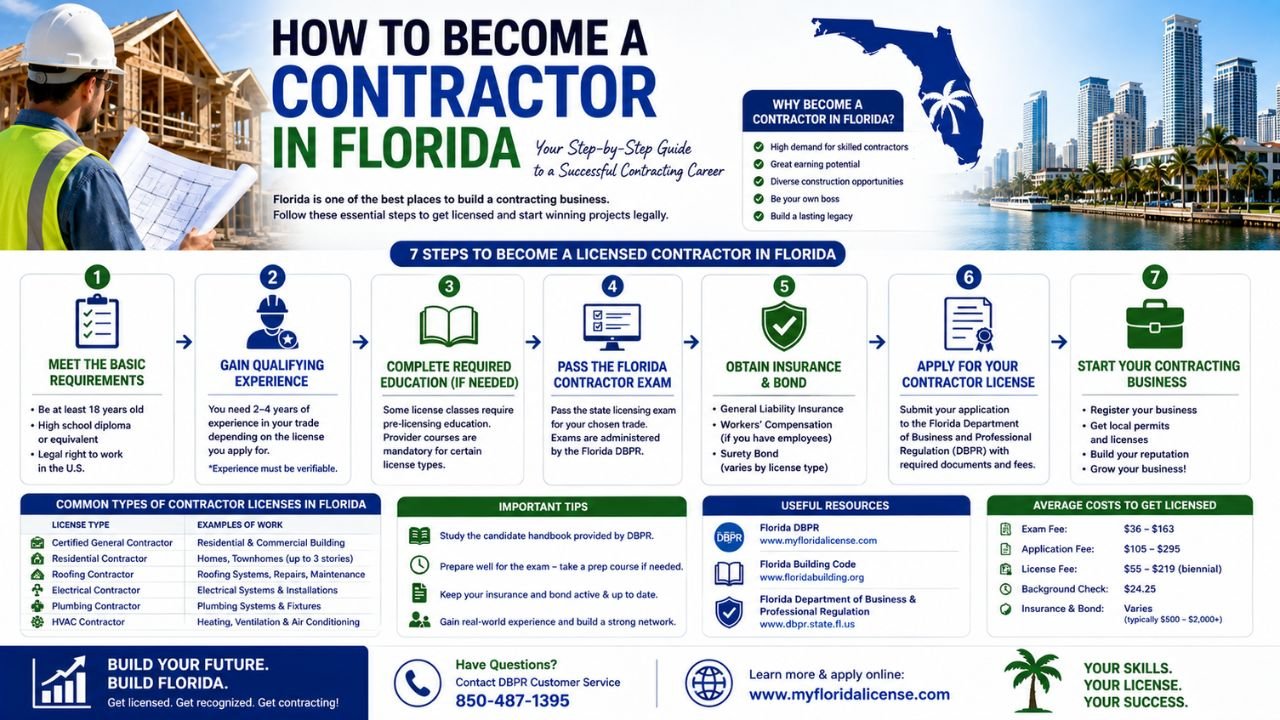
Before submitting your application to the state, you must identify the license category that matches your trade experience and business objectives. Florida categorizes main structural construction licenses into three main pathways:
-
Residential Contractor (CRC / RRC): Restricts work to one-family, two-family, or three-family residences and related accessory structures (such as detached garages or sheds). Buildings cannot exceed two stories in height.
-
Building Contractor (CBC / RBC): Permits construction, remodeling, and repair of commercial structures and residential buildings up to three stories in height. Building contractors can also perform structural work on taller buildings if structural integrity is not compromised.
-
General Contractor (CGC / RGC): Grants unlimited authority regarding building height, structural scope, and property type. General contractors can construct, alter, or repair any commercial, industrial, or residential structure in the state.
| License Category | Height Restrictions | Project Scope | Best Suited For |
| Residential Contractor | Max 2 Stories | Single-family homes, duplexes, triplexes, residential remodels | Home builders, residential framing and remodeling specialists |
| Building Contractor | Max 3 Stories | Commercial properties, multi-family housing, structural repairs | Commercial remodelers, multi-family builders, light commercial contractors |
| General Contractor | Unlimited | High-rises, industrial complexes, commercial centers, residential | Commercial builders, heavy civil contractors, large enterprise firms |
Choosing your specific license tier early determines the type of project documentation you must collect and the exam content you will take.
Certified vs Registered Licenses
Florida distinguishes between two distinct operational license structures: Certified and Registered. Understanding these options ensures you select a pathway aligned with your long-term growth goals.
-
Certified Contractor License (Statewide): Allows you to pull permits and contract anywhere in Florida. Certified contractors pass the state examination administered through the state board, and their license number begins with a C (e.g., CGC, CBC, CRC).
-
Registered Contractor License (Local Jurisdiction): Authorizes work only within a specific municipality or county where you hold a local certificate of competency. Registered contractors cannot work outside their designated local boundary without obtaining additional local approvals, and their license number begins with an R (e.g., RGC, RBC, RRC).
Most ambitious professionals pursuing a Florida contractor license aim for certification to work freely across all Florida cities and counties.
Experience and Education Requirements
To satisfy state standards, applicants must prove technical capability through field work or academic study. The Florida Construction Industry Licensing Board (CILB) outlines three primary qualification tracks:
-
Field Experience Route: Requires four years of active trade experience, with at least one year functioning as a foreman or supervisor.
-
Degree Route: A four-year accredited bachelor’s degree in construction, architecture, or engineering, paired with one year of proven supervisory experience. (Applicants with a 3.0+ GPA in a construction degree may also qualify for trade exam exemptions under state guidelines.)
-
Combined Route: A mixture of accredited college credits and field work totaling four years, provided at least one year includes supervisory trade duties.
Candidates seeking Building or General Contractor licensure must demonstrate active structural experience in specific areas, such as foundations, masonry walls, steel erection, formwork, elevated slabs, or column erection.
Gaining a complete view of project management helps candidates document experience accurately. For example, understanding what are the 7 stages of construction enables site foremen to detail their supervisor duties, while mastering residential construction estimating helps trade professionals excel in project budgeting and board review.
Exam and Application Process
Earning your builder certification requires passing the state examination and presenting a complete application packet:
-
Select Your Licensing Path: Determine whether Residential, Building, or General Contracting fits your portfolio.
-
Pass the Florida State Construction Examination: The exam is open-book, timed, and split into key sections:
-
Business and Finance: Covers Florida lien laws, tax regulations, payroll, contracts, and financial accounting.
-
Trade Knowledge & Contract Administration: Tests building codes, OSHA standards, plan reading, concrete framing, and structural execution.
-
-
Submit Your DBPR Application: Fill out the required forms from the Florida Department of Business and Professional Regulation (DBPR).
-
Verify Experience: Provide tax documents, W-2s, or signed affidavits from licensed contractors confirming your supervisory field experience.
-
Pay Licensing Fees: Include state application processing fees payable to the CILB.
Financial, Insurance, and Background Requirements
Florida enforces strict financial responsibility and public safety standards before issuing an active license.
Credit Score and Financial Responsibility
Applicants must submit a personal credit report showing a FICO credit score of 660 or higher. If your credit score is below 660, you can meet state requirements by taking a board-approved 14-hour financial stability course or securing a contractor license bond ($20,000 bond for Division I contractors).
Insurance Requirements
Contractors must carry general liability insurance and property damage coverage before pulling permits:
-
General and Building Contractors: Minimum $300,000 public liability and $50,000 property damage coverage.
-
Residential Contractors: Minimum $100,000 public liability and $25,000 property damage coverage.
-
Workers’ Compensation: Must obtain coverage or an official state exemption prior to active contracting.
Background Check & Fingerprinting
Applicants must complete electronic fingerprinting through a vendor approved by the Florida Department of Law Enforcement (FDLE). Criminal history disclosures are reviewed individually by the licensing board.
Business Setup After Licensure
Securing your license is the first step toward running a fully compliant contracting enterprise:
-
Entity Registration: Register your business entity (LLC or Corporation) with the Florida Division of Corporations (Sunbiz).
-
Qualifying the Business: File an application with the DBPR to designate your personal contractor license as the official Qualifying Agent for your company.
-
Tax Accounts: Set up a Federal Employer Identification Number (FEIN) with the IRS and register with the Florida Department of Revenue.
-
Operational Systems: Implement cloud accounting, bidding software, project scheduling tools, and contract templates formatted to meet Florida’s Construction Lien Law (Chapter 713, Florida Statutes).
How to Prepare: Practical Steps on How to Become a Contractor in Florida
Aspiring contractors can take proactive steps today to build an undeniable license application:
-
Work Under Licensed Mentors: Ensure your jobsite hours are logged under an actively licensed certified or registered contractor who can sign off on your supervisory experience.
-
Maintain Detailed Job Logs: Track project addresses, structural scopes, dollar values, and specific supervisory responsibilities (e.g., managing sub-trades, reading blueprints, controlling concrete pours).
-
Pursue Continuing Education: Take specialized trade courses recognized by the Florida Department of Education or accredited trade institutions.
-
Monitor Personal Credit: Keep personal accounts in good standing so your financial responsibility verification goes smoothly.
Costs and Time: How to Become a Contractor in Florida
The investment required when figuring out how to become a contractor in Florida depends on your prep resources, license class, and business structure.
Estimated Startup Costs
-
Exam Registration & Testing Fees: ~$250–$350
-
Code Books & Prep Courses: ~$1,000–$2,200
-
DBPR Initial Application Fee: ~$205–$305
-
FDLE Fingerprinting Fee: ~$50–$85
-
Initial Insurance & Workers’ Comp Setup: ~$1,200–$3,500+
Essential Business Cost References
Accurate job costing protects your working capital once licensed. When preparing project estimates, evaluating how much does it cost to build a house in Florida provides clear residential cost benchmarks, while utilizing a sample BOQ for house construction excel complete format with example guarantees structured line-item estimating. If you plan to expand into commercial development, reviewing how much does it cost to build a warehouse in Florida helps establish baseline commercial bidding numbers.
Candidates who meet the four-year construction experience requirement generally spend 3 to 6 months completing exam prep, passing state tests, gathering documentation, and securing board approval.
Final Thoughts
Understanding how to become a contractor in Florida requires careful planning, rigorous exam preparation, and strict compliance with state regulations. By selecting the right license path—Residential, Building, or General Contractor—and systematically documenting your supervisory field experience, you set a strong foundation for board approval. Invest in official code reference books, maintain clean financial records, and establish strong estimating procedures to build a profitable, legally compliant construction business in Florida.