How much does it cost to paint the outside of a house in Florida? A professional exterior painting project commonly costs approximately $1.50 to $5.00 per paintable square foot. Many standard Florida homes fall within an approximate total range of $3,000 to $10,000, while large, two-story, coastal, highly detailed, or heavily damaged homes can cost more.
These are planning ranges—not guaranteed quotes. The final cost to paint exterior house Florida homeowners pay depends on the actual exterior wall area, surface material, paint system, preparation, access, labor rates, location, and current market conditions. A home’s listed interior floor area is not the same as its paintable exterior surface area.
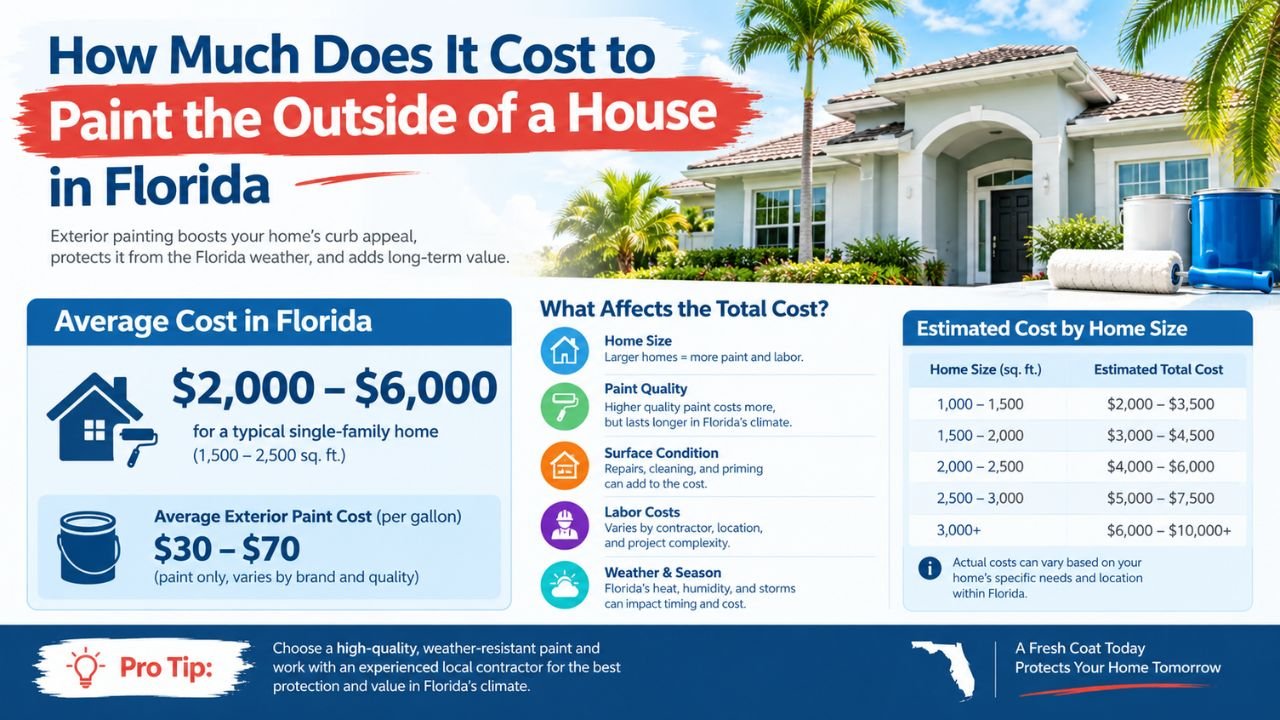
For example, a 2,000-square-foot home may have approximately 2,000 to 3,000 or more square feet of paintable exterior surfaces after accounting for walls, trim, soffits, fascia, doors, garage surfaces, and architectural details.
Average Cost to Paint a House Exterior in Florida
The average exterior house painting cost in Florida varies widely because homes differ in size, height, materials, condition, and design. The following figures are reasonable budgeting ranges for professional exterior painting with standard preparation.
The ranges above are based on paintable exterior surfaces—not simply the home’s interior floor area. A professional estimate may measure wall elevations separately and then add doors, shutters, soffits, fascia, columns, railings, garages, and other painted elements.
Published Florida cost references also show broad variation. One Florida cost guide reports approximately $2 to $4.50 per square foot, while local-market estimates can be lower or higher depending on the scope and preparation requirements.fixr+1
Paint-only versus complete project pricing
It is important to distinguish material-only pricing from a complete professional project.
Paint-only pricing may appear inexpensive because it excludes labor, surface repairs, access equipment, masking, and disposal. For a Florida home, preparation and labor often make up a substantial portion of the final price.
Exterior Painting Cost Per Square Foot
Contractors generally calculate exterior painting costs using paintable square footage. This is different from the home’s interior floor area.
Areas considered in an estimate
A complete measurement may include:
-
Exterior wall elevations.
-
Gables and dormers.
-
Trim around windows and doors.
-
Shutters and decorative elements.
-
Soffits and fascia.
-
Exterior doors.
-
Garage doors.
-
Columns, porches, railings, and balconies.
-
Foundation walls or low masonry sections.
-
Siding, stucco, concrete block, brick, or metal surfaces.
A contractor may start with the wall length multiplied by wall height, subtract major openings, and then add detail areas separately. Some companies use a simplified pricing model based on the home’s floor area, but an itemized measurement is usually more reliable.
What a per-square-foot price may include
A quoted per-square-foot price may include:
-
Standard labor.
-
Exterior paint.
-
Primer where normally required.
-
Light pressure washing.
-
Minor scraping and sanding.
-
Basic caulking.
-
Masking and protection.
-
Two finish coats in selected areas.
-
Standard cleanup.
The estimate may price these items separately:
-
Extensive stucco crack repair.
-
Wood replacement.
-
Rotten trim or fascia.
-
Heavy mildew or algae treatment.
-
Lead-safe preparation.
-
Lift, scaffold, or special access equipment.
-
Extensive color changes.
-
Removal of failing coatings.
-
Painting difficult metal surfaces.
-
Repairs caused by leaks or storm damage.
Always ask whether the quoted rate is based on interior floor area, exterior wall area, or a contractor’s standard estimating formula.
Cost by Home Size and Number of Stories
A two-story home often costs more than a similar one-story home because the crew may need ladders, lifts, scaffolding, additional protection, and more time to reach upper elevations.
Complex rooflines, steep slopes, narrow side yards, balconies, dormers, and high gables can increase the labor requirement even when the home is not exceptionally large.
These figures assume ordinary access and moderate preparation. A small two-story home with difficult access may cost more than a larger one-story home with open access and sound surfaces.
Two-story work can cost more because of:
-
Ladder repositioning.
-
Lift rental or scaffold installation.
-
Slower production at upper elevations.
-
Additional safety controls.
-
Difficult rooflines and architectural details.
-
More masking around balconies, windows, and roof edges.
Cost by Exterior Material
The exterior material has a major effect on the cost to repaint a stucco house in Florida or any other type of home.
Stucco
Stucco is common throughout Florida, but it may require more preparation than smooth siding. Contractors may need to:
-
Repair hairline or larger cracks.
-
Remove chalking or failing paint.
-
Treat mildew and algae.
-
Apply masonry primer or sealer.
-
Use an elastomeric coating where appropriate.
-
Work carefully around control joints and textured surfaces.
A stucco home with minor preparation may cost approximately $1.75 to $5.00 or more per paintable square foot.
Concrete block and masonry
Concrete block can be porous and uneven. It may absorb more coating, particularly when unpainted, weathered, or heavily textured. Masonry paint, bonding primer, or a suitable sealer may be necessary.
Budget approximately $1.75 to $5.00 per paintable square foot, depending on the block condition and coating system.
Wood siding
Wood siding may require scraping, sanding, caulking, spot priming, and replacement of damaged boards. Older wood surfaces can require substantially more preparation than newer siding.
Typical planning range: $1.75 to $5.00 per paintable square foot.
Fiber cement siding
Fiber cement is usually relatively uniform, but exposed edges, joints, prior coatings, and trim details still affect the cost. A sound surface may fall near the middle of the general range.
Typical planning range: $1.50 to $4.00 per paintable square foot.
Vinyl siding
Vinyl siding may be less expensive to paint when it is clean, accessible, and in good condition. The paint must be suitable for vinyl and the color selection should be considered carefully to reduce heat-related performance problems.
Typical planning range: $1.50 to $3.50 per paintable square foot.
Brick
Painting brick requires thorough cleaning, appropriate masonry products, and careful consideration of the desired finish. Porous brick may consume more material.
Typical planning range: $2.00 to $5.00+ per paintable square foot.
Metal surfaces
Metal siding, railings, doors, and other surfaces may require rust removal, abrasion, bonding primer, and specialized coatings. Rusted or previously poorly painted metal can significantly increase preparation costs.
Florida Paint and Coating Options
Paint selection affects material cost, coverage, application method, and suitability for Florida conditions.
Exterior acrylic latex
Exterior acrylic latex is commonly used for siding, trim, and many previously painted surfaces. It is generally flexible and available in a wide range of colors and finishes.
Premium acrylic paint
Premium acrylic products may cost more per gallon but can offer better coverage or application characteristics. However, a higher-priced product does not automatically make every project more economical. The substrate, preparation, number of coats, and application conditions still matter.
Masonry paint
Masonry paint is designed for concrete, block, stucco, and related surfaces. It may be appropriate where vapor movement, porosity, and surface texture are important considerations.
Elastomeric coatings
Elastomeric coatings are flexible coatings sometimes used on stucco and masonry. They may help bridge certain small surface cracks when the substrate is properly prepared, but they are not a substitute for repairing significant movement, leaks, structural problems, or failed joints.
Mildew-resistant coatings
Florida’s moisture and humidity can contribute to mildew and algae growth. Mildew-resistant products may be useful, but the surface should still be cleaned and corrected before painting.
Coastal or salt-air-resistant products
Homes near the Atlantic or Gulf coast may experience salt air, wind-driven moisture, and accelerated surface weathering. A suitable coating system, regular cleaning, and thorough preparation can be important in coastal areas.
Primer and sealers
Primer may be needed for:
-
Bare wood.
-
Chalky surfaces.
-
New masonry.
-
Repaired stucco.
-
Rust-prone metal.
-
Strong color changes.
-
Areas with stains or uneven absorption.
The correct primer depends on the surface and the finish-coat system. It should not be treated as an optional line item when the substrate requires it.
What Is Included in a Professional Exterior Painting Estimate?
A detailed estimate should explain what the contractor will do before, during, and after painting.
The table contains a typographical issue in many draft estimates: “M mildew treatment” should be read as mildew treatment.
A written estimate should also identify the number of coats, surfaces included, product type, color changes, repair limits, access assumptions, and exclusions.
For larger renovation or construction projects, a broader residential construction estimating process can help coordinate painting with repairs, roofing, siding, windows, and other scopes.
Florida Factors That Affect Exterior Painting Costs
Florida-specific conditions can change both the preparation requirements and the appropriate coating system.
Heat and humidity
High heat and humidity affect drying time, worker productivity, and scheduling. Paint may not perform properly if applied to a damp, overheated, or poorly prepared surface.
Strong UV exposure
Florida sunlight can fade colors and weather exterior coatings. Dark colors, exposed elevations, and poorly protected surfaces may require careful product selection.
Heavy rain
Rain can interrupt preparation and painting. Water may also reveal leaks, failed caulking, open joints, or damaged trim that should be corrected before coating.
Mildew and algae
Mildew and algae are common concerns in humid or shaded areas. Washing alone may not resolve the underlying moisture issue, especially where gutters, drainage, landscaping, or ventilation contribute to dampness.
Salt air near the coast
Salt air can affect metal, fasteners, railings, and exterior coatings. Coastal homes may require additional cleaning, corrosion preparation, and suitable paint products.
Wind and storm damage
Wind-driven rain, flying debris, and storms can damage siding, soffits, fascia, trim, and stucco. Painting over damaged materials may hide problems temporarily without correcting them.
Regional differences
Florida home exterior painting prices may differ between:
-
Miami and Fort Lauderdale.
-
Tampa and St. Petersburg.
-
Orlando.
-
Jacksonville.
-
Southwest Florida.
-
The Florida Keys.
-
Smaller inland communities.
Labor availability, travel distance, local demand, access, supply costs, and the type of housing stock all influence pricing.
Construction and repair work may also involve local requirements. When painting is part of a broader alteration or remodeling project, review applicable information through the Florida Building Code and confirm project-specific requirements with the appropriate local authority.
Older homes deserve additional attention. If a home was built before 1978 and painted surfaces will be disturbed, review the EPA Lead-Safe Renovation Information. The EPA states that firms performing covered renovation work that disturbs lead-based paint in pre-1978 housing generally need appropriate certification and lead-safe work practices.epa+1
Labor, Preparation, and Repair Costs
Preparation can represent a substantial portion of the total exterior painting price. A surface that looks acceptable from the street may still require cleaning, scraping, caulking, priming, or repair.
Common preparation tasks include:
-
Pressure washing.
-
Scraping loose paint.
-
Sanding rough or peeling areas.
-
Caulking windows, doors, and selected joints.
-
Repairing stucco cracks.
-
Patching masonry.
-
Replacing damaged wood.
-
Removing or treating mildew.
-
Priming bare or repaired surfaces.
-
Repairing trim, fascia, soffits, or siding.
-
Providing ladders, lifts, or scaffolding.
A low quote may exclude several of these items. For example, one contractor may include pressure washing, minor crack filling, primer, and two finish coats, while another may price only the finish paint application.
For homeowners, builders, property managers, and investors, comparing itemized scopes is more useful than comparing only the bottom-line price.
How to Calculate the Amount of Paint Needed
A basic paint quantity calculation follows these steps:
-
Measure the exterior wall areas.
-
Subtract major windows, doors, and other openings.
-
Add trim, soffits, fascia, shutters, garages, and other painted elements.
-
Determine the number of finish coats.
-
Check the manufacturer’s coverage rate.
-
Add primer where required.
-
Include a reasonable waste and touch-up allowance.
Sample calculation
Assume a hypothetical Florida home has:
-
Net wall area after subtracting major openings: 2,200 square feet.
-
Trim, doors, soffits, and fascia: 500 square feet.
-
Total paintable area: 2,700 square feet.
-
Two finish coats.
-
Product coverage: 350 square feet per gallon per coat.
-
Waste and touch-up allowance: 10%.
Finish paint required:
With a 10% allowance:
The project would require approximately 17 gallons of finish paint, subject to the actual product, surface texture, application method, and packaging sizes.
If primer is needed on 800 square feet at one coat, with the same theoretical coverage:
With waste:
That suggests approximately 3 gallons of primer.
Textured stucco, porous concrete block, bare wood, and heavily weathered surfaces may consume more material than smooth, previously painted siding. Always verify the product data sheet rather than relying only on a general coverage assumption.
How to Prepare an Exterior Painting Estimate
A reliable Florida house painting estimate should be developed systematically.
-
Inspect the home. Document height, access, condition, moisture, peeling, cracks, mildew, and damaged components.
-
Identify surface materials. Separate stucco, concrete block, wood, fiber cement, vinyl, brick, metal, and trim.
-
Measure paintable areas. Calculate elevations, subtract openings, and add trim and details.
-
Assess repairs and preparation. List pressure washing, scraping, sanding, caulking, crack repair, patching, replacement, and primer.
-
Select the coating system. Specify the primer, finish paint, number of coats, sheen, and any masonry or elastomeric product.
-
Calculate paint and materials. Include gallons, primer, caulk, patching compound, masking materials, abrasives, cleaners, and disposal supplies.
-
Estimate labor and equipment. Account for crew size, production rates, ladders, lifts, scaffolding, setup, protection, and cleanup.
-
Add overhead, contingency, and markup. Include supervision, insurance-related business costs, administration, transportation, and reasonable project risk.
-
List assumptions and exclusions. State what happens if concealed damage, lead-based paint, extensive wood rot, or difficult access is discovered.
The construction cost estimator Florida resource can help organize broader project costs. For repeatable estimating, a construction estimate template for Excel or construction estimate format Excel worksheet can separate quantities, unit prices, labor, equipment, and markup.
Using Excel to Organize the Estimate
An Excel estimate can help a contractor or property manager track every component of an exterior painting project.
Useful columns include:
-
Surface area.
-
Surface type.
-
Preparation description.
-
Primer product.
-
Finish paint product.
-
Number of coats.
-
Gallons.
-
Unit cost.
-
Material total.
-
Labor hours.
-
Hourly labor rate.
-
Equipment.
-
Overhead.
-
Markup.
-
Final project cost.
Common formulas include:
A structured house estimate format in Excel can be adapted for exterior painting, remodeling, and repair scopes. For more detailed documentation, review the detailed estimate of a residential building in Excel PDF for Florida and the sample BOQ for house construction Excel complete format with example.
These formats are especially useful when exterior painting is one part of a larger scope involving roofing, windows, siding, stucco repair, or additions. Understanding the broader 7 stages of construction can also help place painting at the correct point in a renovation or new-build schedule.
Ways to Reduce Exterior Painting Costs
Reducing cost does not always mean choosing the lowest quote. The objective is to reduce avoidable work while maintaining an appropriate coating system and complete scope.
-
Compare complete scopes, not just total prices.
-
Repair obvious surface problems before requesting final bids.
-
Ask each contractor to identify preparation separately.
-
Choose a coating system appropriate for the substrate and climate.
-
Schedule work during favorable weather when practical.
-
Reduce unnecessary color changes that require additional masking or coats.
-
Confirm whether trim, doors, soffits, fascia, shutters, and garages are included.
-
Obtain multiple itemized estimates.
-
Keep landscaping and access areas clear before the crew arrives.
-
Ask how concealed damage will be handled if discovered.
Avoid choosing the cheapest contractor or least expensive paint without reviewing preparation, product specifications, number of coats, cleanup, and any written warranty terms. A lower initial price can become more expensive if peeling, mildew, missed surfaces, or repair changes appear shortly after completion.
Questions to Ask Before Hiring a Painter
Before approving a proposal, ask:
-
Is the estimate based on paintable exterior area or interior floor area?
-
Is pressure washing included?
-
Are repairs and crack filling included?
-
Is primer included?
-
How many finish coats will be applied?
-
What type and brand of paint will be used?
-
Are trim, doors, soffits, fascia, shutters, and garage doors included?
-
Are ladders, lifts, or scaffolding included?
-
How will rain and humidity affect scheduling?
-
Will mildew treatment be included where necessary?
-
How will wood rot, stucco damage, or concealed defects be priced?
-
Is cleanup and disposal included?
-
What assumptions and exclusions are included?
-
Is the estimate itemized?
-
Are color changes priced separately?
-
Does the estimate identify the areas receiving one coat or two coats?
For projects involving construction changes, repairs, or additions, homeowners may also review information about how to get a building permit in Florida. Painting alone may not raise the same questions as structural work, but combining painting with alterations can change the project’s requirements.
Final Thoughts
So, how much does it cost to paint the outside of a house in Florida? A practical planning range is approximately $1.50 to $5.00 per paintable square foot, with many standard homes costing about $3,000 to $10,000 for a professional exterior painting project.
Large, two-story, coastal, heavily damaged, highly detailed, or difficult-to-access homes can exceed those ranges. The final cost to paint a house outside Florida depends on surface type, preparation, paint quality, labor, access equipment, local conditions, and the project’s location.
The most useful next step is to request an itemized estimate that separates paint, primer, repairs, preparation, labor, equipment, overhead, and contingency. That makes it easier to compare proposals accurately and develop a realistic Florida exterior painting budget.